

Can the evaluator sitting across from a vendor proposal actually explain, in one sentence, why a moving company’s local-move lead should be scored differently from its long-distance lead before either one reaches a follow-up call?
Most cannot, and most proposals do not force the question. Agencies bundle “moving company marketing” into a single package priced by traffic or by lead count, as if a household relocating twelve blocks and a household relocating across three states convert through the same funnel, close at the same margin, and deserve the same follow-up cadence.
They do not. The rest of this comparison treats that difference as the starting condition for every vendor decision that follows, not a footnote to it.
What Should a Moving Company Expect Digital Marketing to Accomplish?
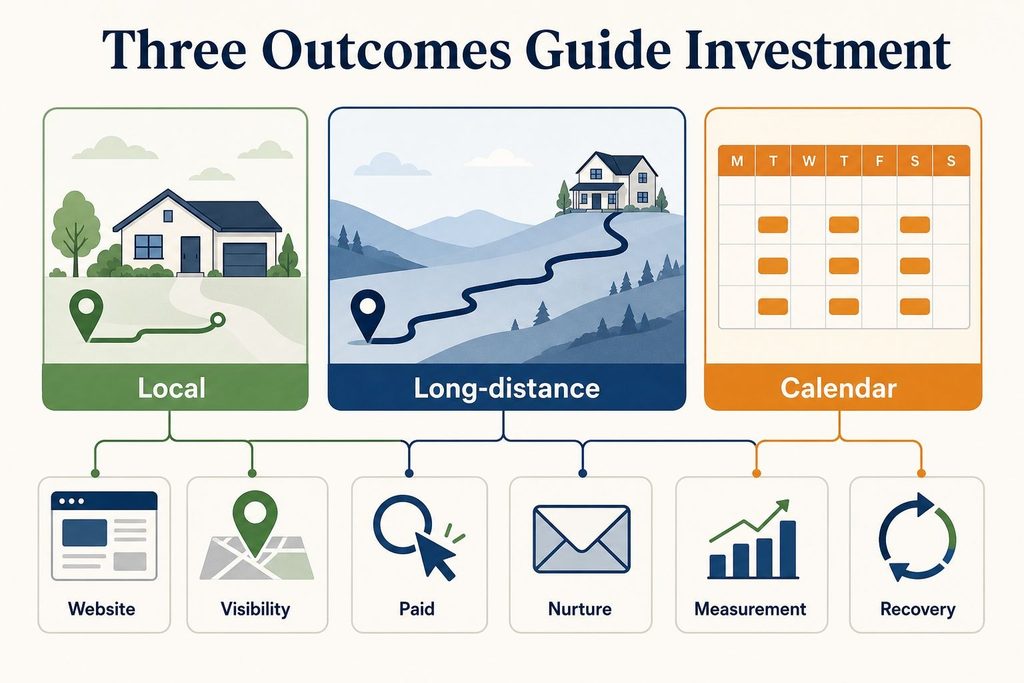
Three outcomes govern selection, and they are not interchangeable. Residential relocation marketing exists to create estimate-ready local demand: households searching for a mover this month, in a service area the company already trucks. Long-distance moving promotion does something different. It favors routes with better margin and screens out inquiries that will never convert into a signed long-haul job, because a long-distance lead that dies at the estimate stage costs more in dispatch time than it ever returns.
The third outcome, booking calendar optimization, is the one most proposals skip entirely. Filling slow weeks and protecting crew capacity during peak season matters more than pushing form-fill volume to a number that looks good in a monthly report.
Website structure, local visibility work, paid acquisition, lead nurture, measurement, and lead recovery are not a fixed package to be accepted as a set. They are six separate services, each judged against whichever of the three outcomes it actually serves.
A vendor that cannot say which service maps to which outcome has not built a strategy. It has built a menu.
How Should Agencies Be Compared Before Any Service Is Chosen?
Before any single channel gets funded, the same nine dimensions should be applied to every provider under consideration, regardless of how the provider describes itself:
- Moving-category fit: has the agency worked with movers specifically, or is moving one vertical among many unrelated ones?
- Residential versus long-distance strategy: does the proposal separate these two, with different targeting, different qualification logic, and different reporting?
- Service scope: which of the six services above are actually included, and which are upsells?
- Case studies: are they from moving companies, with comparable market size and season?
- Client reviews and references: can the evaluator contact a live client, not just read a testimonial page?
- Pricing model and asset ownership: is pricing flat, percentage-of-spend, or hybrid, and who owns the ad accounts and content if the contract ends?
- Service-level agreement: what response times and deliverables are contractually guaranteed?
- Technology stack: what CRM, call tracking, and attribution tools does the agency use or integrate with?
- Reporting access: does the evaluator get direct dashboard access, or only a monthly PDF?
Applying this list to three common provider types produces three different evidence burdens. A moving-specialist agency should be able to produce case studies from comparable moving companies, references who took the same category of engagement, and a stack built for call-heavy, estimate-driven sales cycles.
For a full-service option in this category, the client’s own moving company digital marketing services page is one example of how that scope gets described, though naming it here is not an endorsement that this is the correct tier for every evaluator’s constraint.
A generalist agency handling several home-service verticals may still pass the test, but it needs to show moving-specific results, not adjacent-industry proxies like HVAC or roofing leads presented as if the qualification logic transfers.
A single-channel provider, one that only runs paid search or only does SEO, is not disqualified by scope alone. It is disqualified only if it cannot name which of the three business outcomes its one channel is meant to serve, and cannot produce reporting that isolates that channel’s contribution.
Which Local Visibility Services Create Estimate-Ready Residential Demand?
Local SEO, Google Business Profile management, city and service-area pages, review generation, and local backlinks are the levers that determine whether a household finds the company at all when searching for a mover nearby.
A 2026 construction and services playbook describes these as the core mechanisms for improving visibility in Google Maps results, and the logic holds for moving companies specifically:
| a profile that is | one that is |
|---|---|
| 1. claimed | left dormant |
| 2. categorized correctly | |
| 3. kept current with hours and service areas |
outperforms, regardless of how much content sits on the website behind it.
What Must Local SEO Include?
At minimum, service-area pages built for each city or region actually served, not a single generic “areas we cover” list; a review-generation process that produces a steady flow of recent reviews rather than a burst followed by silence; and backlinks from locally relevant sources rather than paid directory placements bought in bulk.
What a Weak Local SEO Package Looks Like
The gap usually shows up in the same three places. Service-area pages get duplicated with a city name swapped in and nothing else changed, which search engines treat as thin content rather than genuine coverage. Review requests go out once after a job and never again, so the profile shows a cluster of dated reviews instead of a living record. And backlinks arrive from a paid batch of directory sites with no geographic or industry relevance, which does little for map-pack ranking and can flag as manipulative.
What Should Reporting Show?
Reporting should isolate map-pack visibility, organic ranking movement for city-and-service terms, and review velocity, tied to the service areas the mover actually trucks. Any proposal that promises a specific multiple of lead growth within a fixed number of days, without showing the client’s own historical data behind that number, should be treated as marketing copy rather than a forecast.
When Are Google Ads and Local Services Ads Worth the Cost?
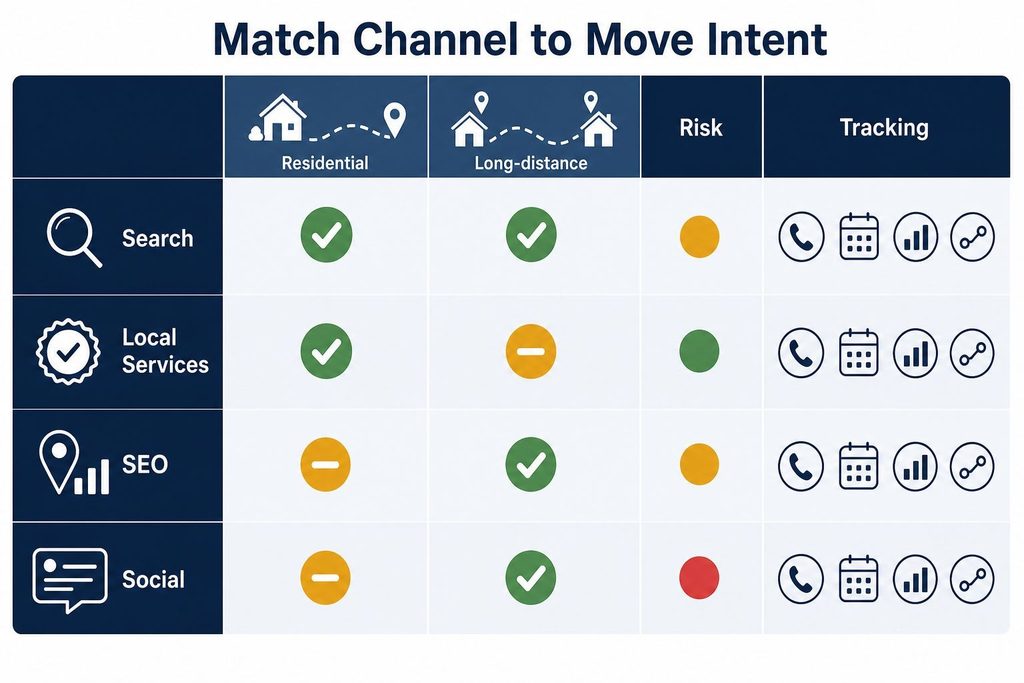
Paid channels earn their budget only when an agency can show how residential urgency and long-distance intent get separated before a click ever becomes a lead. The four channels below are not equally suited to the two move types, and that mismatch is where paid budget is most often wasted.
| Channel | Best Job Type | Qualification Risk | Measurement Requirement |
|---|---|---|---|
| Search Ads | Residential, time-sensitive | High without negative keywords | Call tracking tied to keyword |
| Local Services Ads | Residential, trust-driven | Moderate, platform pre-screens | Booked-job tie-back, not just leads |
| Organic Local SEO | Both, slower to build | Low once ranked | Rank tracking plus lead source tagging |
| Paid Social | Awareness, long-distance research phase | High, needs longer nurture | Multi-touch attribution, not last-click |
Search ads move fast on residential urgency but leak budget quickly without disciplined negative-keyword lists and call handling that can tell a real estimate request from a price-shopper. Local Services Ads carry a built-in screening layer, useful for residential trust signals, but still require tie-back to booked jobs rather than raw lead count. Paid social rarely produces an immediate booking; it works the long-distance research phase, where the decision cycle runs weeks, not days.
Before any paid budget expands, the agency should disclose management fees separately from media spend, show search-term reports that prove negative-keyword discipline, and demonstrate that calls are recorded and scored, not merely counted.
What Must a Moving Website, Social Program, and Email Program Do Together?
Outside of search and paid channels, the website, social presence, and email program have one job collectively: move a warm inquiry toward a booked estimate without losing it in a generic content funnel. The selection standard separates what a proposal must include from what is merely nice to have.
Required conversion functions:
- Estimate-request paths that are two steps or fewer from any entry page, not buried under a general contact form.
- Landing pages matched to campaign intent, so a long-distance search ad does not land on a page written for local movers.
- Social proof and retargeting that reintroduce a household that requested a quote but did not book, rather than treating them as a lost lead.
- Compliant email follow-up, with clear unsubscribe handling and documented consent at the point of collection.
Optional content production, blog posts, seasonal moving-tips articles, video series, adds value over time but should never be substituted for the four functions above in a proposal. Compliance review belongs here as a risk check, not a performance claim: GDPR and the CAN-SPAM Act should be addressed in terms of consent capture, unsubscribe mechanics, and data-handling responsibility, with a named party accountable if either breaks down. Neither law should appear in a proposal as a driver of lead volume.
How Can a Moving Company Verify Agency ROI Before Scaling?

No proposal should receive an expanded budget until its reporting has been tested against real operational data, not the agency’s own summary slide. Results tracking is the mechanism that separates a vendor worth scaling from one that has simply produced a good-looking dashboard.
Which Metrics Must Be Transparent?
Six figures matter, and each answers a different question rather than serving as a single combined score.
- Conversion rate shows how well traffic turns into inquiries.
- Cost per lead shows channel efficiency in isolation.
- Return on ad spend ties media cost to revenue, not just leads.
- Qualified leads filters out inquiries that were never going to book, which matters enormously for long-distance campaigns prone to unqualified volume.
- Customer acquisition cost rolls media, management fees, and internal handling time into one number.
- Calendar fill rate measures whether bookings actually land in the weeks and months that need them, which is the outcome traffic metrics alone cannot show.
No agency should hand over a fixed benchmark for any of these figures as if it applies universally. The decision use of each number depends on the company’s own historical baseline, and a vendor proposing to set the number without seeing that baseline first is proposing a guess.
Where Do Leads Leak Before Booking?
The most common failure point sits between inquiry and estimate, and between estimate and follow-up, not in the traffic-generation channels themselves. A lead that arrives through a well-optimized Google Business Profile still needs a fast, trained response, and customer-service handling errors at that stage will erase the value of every dollar spent generating the inquiry.
CRM integration, call tracking, and form attribution need to be owned clearly, with lead-status definitions (new, contacted, estimated, booked, lost) agreed in writing, and a reporting cadence that shows movement between those statuses, not just a total count at the top.
An SLA should assign specific response-time targets and name who escalates a stalled lead, whether that is agency staff or internal sales. Lead recovery, meaning a documented process for re-engaging inquiries that went cold after an estimate, deserves its own line item, because uncontacted or poorly qualified inquiries do not fill a booking calendar no matter how they were generated.
What Questions Expose a Weak Moving Marketing Proposal?
A short set of direct questions tends to surface the gaps a glossy deck hides. Ask for:
- Comparable residential and long-distance results from actual moving clients, not adjacent verticals.
- Direct contact with a current or former client reference.
- Live reporting access, pricing terms, and cancellation conditions in writing.
- Confirmation of who owns ad accounts, website content, and customer data after the contract ends.
- A documented compliance process for consent and data handling.
- A specific answer for what happens when qualified-lead quality drops, not just volume.
Any proposal that leans on a generic explanation of the 3-3-3 rule or the 70/20/10 rule as proof of strategy, without tying either to the company’s own data, should be treated as filler rather than evidence.
Which Moving Marketing Service Fits the Current Constraint?
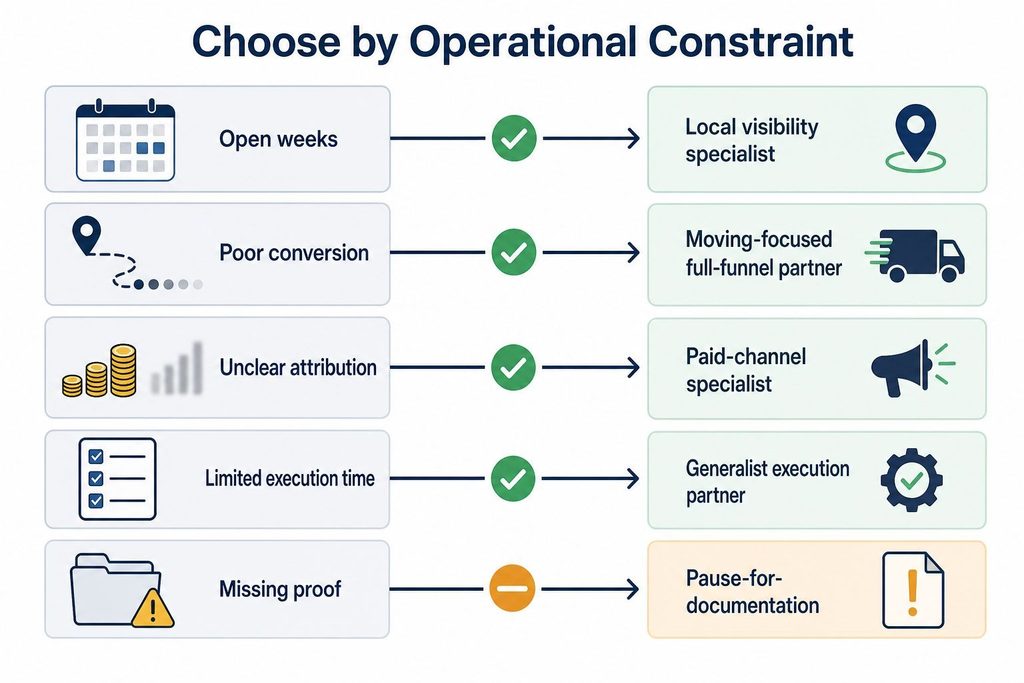
The right choice depends on what is actually broken, not on which agency pitches hardest. A full-funnel, moving-specialist partner earns the recommendation when it can substantiate moving-specific proof and open, checkable attribution. The verdict flips toward a narrower specialist when the constraint is genuinely one channel and internal staff can coordinate the rest without added friction.
Before scheduling the next vendor call, score that agency’s proposal against the nine dimensions above and write down where it falls short.
| Operational Situation | Right Choice |
|---|---|
| Calendar has open weeks and no local visibility problem | Local SEO and Google Business Profile specialist |
| Long-distance leads convert poorly despite strong volume | Moving-specialist full-funnel partner with qualification proof |
| Paid spend is rising with no attribution clarity | Single-channel paid specialist with call-tracking discipline |
| Internal team can manage strategy but lacks execution hours | Generalist agency with moving-adjacent case studies |
| No clear proof, no SLA, no reporting access offered | Do not commit budget until documentation exists |