

Claiming more territory is the least reliable way to get found in it. Businesses that list themselves against a dozen neighboring cities, stack service-area pages by the postal code, or widen every targeting radius they can find usually see less regional traffic, not more, because the signals that decide local placement reward accuracy over reach.
That is a hard thing to accept when the budget conversation is framed as “how many areas should we cover.” The better question is narrower: which signals earn visibility where the business already has legitimate standing, and which spend is better used to buy audience attention rather than earned placement.
What follows separates those two categories cleanly, because conflating them is where most regional marketing budgets get spent twice on the same outcome.
Regional Visibility Is Earned Through Three Local Signals, Not Territorial Claims
Local search placement, inside the map pack and in the organic results beneath it, is decided by three independent dimensions: proximity, relevance, and prominence. None of them can be substituted for another, and none of them respond to a business simply declaring a wider service area.
A company that serves five counties but operates from a single address is not competing evenly across those counties. It is competing on relevance and prominence in the counties farther from that address, while proximity works against it every time.
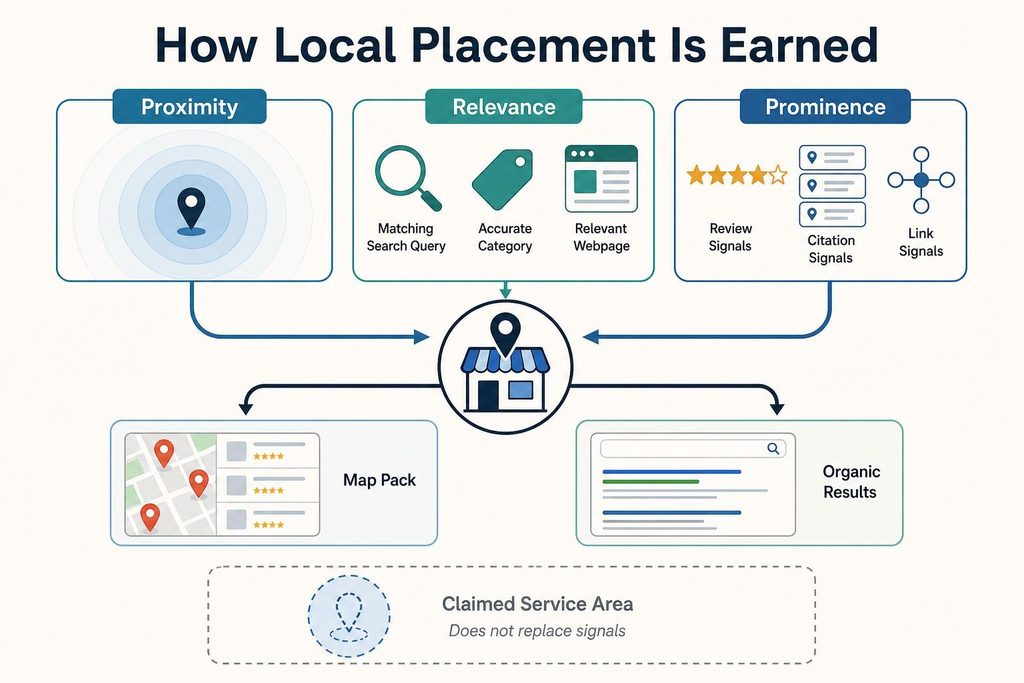
That distinction matters because it sets the honest boundary for this entire subject. Credible regional visibility means ranking well in the map pack and organic results for the areas a business can substantiate, not a guarantee of appearing everywhere a sales team would like leads to originate.
Proximity Cannot Be Talked Around
Proximity measures the distance between the searcher (or the searched location) and the business address on file. A service-area business can serve a wide radius, but the ranking algorithm still weighs distance heavily for map-pack placement, and no amount of content, backlinks, or citation volume overrides that gap entirely.
Relevance and Prominence Do the Rest of the Work
Relevance is whether the business profile, categories, and content actually match the search intent. Prominence is the accumulated evidence, reviews, links, citations, media mentions, that the business is well-established in its space. Both are earnable. Proximity mostly is not, short of opening a physical location.
Why the Research Supports General Tactics, Not City-Specific Promises
Nothing in the available evidence supports claims about how any particular city, neighborhood, state, or zip code behaves differently in search results. Regional differences in competition, search volume, or algorithmic weighting are real in principle, but asserting them for an unnamed market is speculation, not strategy.
This directly answers the recurring question of where the effort should concentrate first. The 80/20 of local search is accurate business presence and demonstrable proof of legitimate service, not dispersed activity across many listings, pages, or platforms.
Fix the fundamentals for a defined set of priority areas before spreading effort thinner.
The Local Map Pack Concentrates the Highest-Intent Local Comparison
The map pack is where local buying decisions get made in seconds. It is commonly described, according to a guide from Search Engine Land, as the top three local business listings shown above the organic results, drawn largely from Google Business Profile data.
That description matters for budget planning because it tells the payer exactly where competitive pressure is concentrated: three slots, pulled largely from profile completeness and signal strength, not from the broader ranking factors that govern standard organic pages.
Standard organic visibility works differently. A business can rank respectably in the organic results for a service query without ever appearing in the map pack for that same query, because the two surfaces weigh proximity and profile signals differently. A payer evaluating regional spend needs to know which surface is being measured before approving budget tied to “ranking better.”
The map pack rewards profile accuracy and proximity; organic results reward broader content and authority signals. Treating them as one metric hides which lever actually moved.
The consequence that matters commercially is not the position number itself. It is what that position produces: phone calls, direction requests, and qualified form leads. A business can occupy the map pack and still see mediocre lead quality if the profile categories mismatch the service, or it can rank third organically and outperform a map-pack competitor on conversion because the landing experience is stronger.
No ranking position in the map pack or the organic results can be guaranteed by any vendor, campaign, or technique. Competitive density, proximity to the searcher, and the business’s own accumulated prominence all move independently of any single optimization effort.
Any promise that ignores that is a promise not worth budgeting against.
Changing the Search Region Only Reveals Results, It Does Not Earn Them
Search results can be made to show a different area’s results by adjusting location settings, using a different search context, or physically moving the device doing the searching. That is a diagnostic technique, useful for checking how a business appears from a specific area, and it directly answers a common question about how to change the region shown in search results.
It does not change anything about how the business earns visibility there.
That distinction gets blurred constantly. Adjusting a location setting to observe results is legitimate research. Asserting a service area, address, or physical presence that does not exist to manipulate how the business appears in that area is a violation of Google Business Profile guidelines and a route to suspension, not visibility.
A short comparison clarifies where the line sits:
- Diagnostic location checks: changing device or account settings to observe how results appear from another area, used for competitive research and QA.
- Manipulative location claims: listing a false address, a fake service area, or duplicate profiles to appear local in places the business does not actually serve.
- Paid geo-fenced advertising: buying ad exposure to audiences inside a defined geographic boundary, independent of organic ranking signals.
- Organic local SEO: earning placement through legitimate relevance, prominence, proximity, and accurate entity data across the web.
Geo-fencing and organic visibility solve different problems and neither substitutes for the other. Geo-fencing buys attention in a boundary for as long as the budget runs.
Organic local SEO builds a standing asset that keeps producing visibility after the spend stops, but only where the underlying business presence supports it.
A Complete Business Presence Removes the Regional Visibility Ceiling
Before any content strategy, backlink outreach, or paid targeting decision gets approved, the Google Business Profile needs to be correct. This is unglamorous work, and it is also the highest-value work available, because an incomplete or miscategorized profile puts a ceiling on every other tactic layered on top of it.
Profile and Service Area Accuracy Comes First
The primary category has to reflect the core service precisely, and secondary categories should only be added where they are genuinely accurate, not where they might catch extra search volume. Service areas listed on the profile should match what operations can actually deliver.
The business name, address, and phone number, commonly abbreviated as NAP, need to match exactly across the website and every listing platform.
Citation Hygiene Is Maintenance, Not Optimization
NAP inconsistency across directories confuses the entity resolution that underlies local ranking, and it should be treated as ongoing cleanup work rather than a one-time project. Duplicate listing removal, correction of outdated citations, and adherence to current Google Business Profile guidelines belong in the same maintenance category as software patching.
Unglamorous, continuous, and the thing that breaks visibility when skipped.
Location Pages Work Only When Operations Can Substantiate Them
A location or service-area landing page earns its place when it reflects something operationally true: a real crew that services that area, a genuine response radius, and details a local customer actually needs before calling. It fails, and often draws a quality penalty, when it exists only to insert a place name into a template.
A credible location page can reasonably include:
- Service boundaries: what is actually covered in that area, stated plainly, including any limits on scope or availability.
- Local references that are accurate: neighborhoods, landmarks, or corridors the business genuinely services, not a scraped list.
- Logistics the customer needs: response times, service windows, or scheduling notes specific to that area.
- A conversion path matched to intent: a call or quote request tied to that area, not a generic contact form buried below unrelated content.
Local backlinks, mentions from area organizations, local press, chambers of commerce, or partner businesses, function as supporting evidence of prominence rather than a page-level ranking trick. A single page cannot manufacture legitimacy that operations do not back.
Unsupported claims of coverage in a city the business does not actually serve create both a compliance risk and a trust problem the moment a customer calls and finds otherwise.
Reputation and Site Experience Determine Whether Regional Relevance Converts
Authentic reviews, timely responses to them, and consistency across review platforms feed directly into prominence, but review volume by itself does not buy placement. A profile with many reviews and no owner responses signals less trust than one with fewer reviews and visible engagement.
Review spam, whether fabricated positive reviews or coordinated negative ones from a competitor, needs active mitigation and reporting, because either distorts the signal Google is trying to read and can trigger a manual review of the whole profile.
Reputation Maintenance Is a Standing Job
Monitoring new reviews across Google, and any secondary platforms relevant to the industry, for accuracy and tone is recurring work. Flagging clearly fabricated reviews, whether suspiciously glowing or suspiciously coordinated, protects the prominence signal rather than gaming it.
Conversion Readiness Decides What Visibility Is Worth
A high-ranking listing still depends on what happens after the click. Mobile usability, page load speed on a cellular connection, and clarity for voice-based queries (the kind spoken into a phone while driving) all determine whether a visitor converts into a call or a lead.
Visibility that lands on a slow, hard-to-navigate mobile page wastes money on both sides of the ledger, the organic effort that earned the placement and any paid geo-fenced spend pointed at the same page.
Area-Level Measurement Turns Regional SEO Into an Accountable Investment
None of the preceding work is worth approving without a way to measure it. The starting point is a baseline captured per priority area, not one number for the whole business, and it should cover four things before anything else gets touched:
- Current map-pack appearance for the core service terms in that area.
- Current organic position for the same terms.
- Current citation accuracy across directories and platforms.
- Current review count and rating.
Without that baseline, any later claim of improvement is unverifiable.
The Metrics Worth Watching
From there, the metrics worth watching on a recurring cycle are the ones tied to revenue, not the ones easiest to pull from a dashboard:
- Map-pack appearance frequency for priority terms matters,
- but so do phone calls attributed to the profile,
- direction requests,
- form conversions broken out by the area a lead claims to be in,
- and the ongoing count of citation or NAP corrections still outstanding.
Lead quality deserves particular attention, since a rise in call volume from an area the business barely serves is not the win it looks like on a report.
This is also the right place to address a commonly asked but poorly framed question: whether a score of 75 on an SEO audit tool is good. It is not a decision metric on its own.
A 75 sitting beside a clean citation profile, no manual actions, and strong area-level conversion is a very different situation than a 75 sitting beside dozens of unresolved NAP conflicts and no map-pack presence in the priority areas. The number needs interpretation against errors present, area-level visibility, and actual business outcomes, never approved or rejected in isolation.
A workable before-and-after framework runs on a fixed interval, comparing the same baseline metrics at 90-day or similar checkpoints, area by area. Alongside it sits a log of what changed operationally: a new location page, a corrected category, a citation cleanup pass.
That log is what turns a coincidental uptick into an attributable one.
It is also worth restating plainly: observing a different result because a search location setting was changed for testing purposes is not a performance change. Only a shift in the actual baseline metrics, measured from a consistent vantage point, counts as movement.
The Next Regional Investment Should Follow the Evidence Already Available
The sequence that holds up under budget scrutiny follows a fixed order:
- Establish the baseline per area.
- Select a small set of priority areas the business can genuinely substantiate.
- Correct and standardize the business presence across profile and citations.
- Build or refine location content only where operations support it.
- Measure against the baseline before expanding coverage further.
Skipping the baseline step is the most common reason regional spend gets approved twice for the same unresolved problem.
For businesses evaluating structured implementation support at this stage, local seo packages are typically scoped around exactly this sequence rather than around a fixed list of deliverables unrelated to the baseline findings.
The choice between organic effort and paid geo-fencing, or both, depends on what the baseline actually shows. The next task does not require a new budget line or a new vendor conversation.
It requires pulling the current map-pack appearance, citation accuracy, and review standing for the three highest-value service areas already on the books, today, and using that baseline as the only starting point for whatever gets approved next.
| Situation | Right Choice |
|---|---|
| Strong profile and citations, but weak conversion in a proven service area | Fix landing page and mobile experience before adding more spend |
| Legitimate service area with no map-pack presence and clean NAP data | Organic local SEO investment, focused on profile and citation depth |
| New or unproven area with no operational history yet | Paid geo-fencing to test demand before committing to organic buildout |
| Established area with strong rankings but flat lead volume | Reputation and conversion-path review, not more location content |
| Multiple areas competing for limited budget with no baseline data | Baseline measurement first, before any spend is allocated |