

More digital marketing spend does not produce more revenue for a dental practice. It produces more visibility, more clicks, sometimes more calls, and none of that converts to income until a prospective cosmetic or implant patient sits in a treatment chair and accepts a plan.
That distinction sounds obvious once stated. It is routinely ignored when a practice signs off on a marketing budget based on traffic reports, keyword rankings, or a vendor’s promise of “more leads.” The right question is not whether a channel gets attention. It is whether that attention can be traced, stage by stage, to a booked high-value consultation. Everything below is built to answer that question rather than to sell another tactic.
Why Is Digital Marketing More Than an Advertising Cost for a Dental Practice?
Treating digital marketing as a line-item advertising cost misreads what it actually does. Its function is to connect two things that would otherwise stay separate: a person already researching a cosmetic or implant procedure, and a specific practice capable of delivering it. The input is demand that already exists, expressed as searches, comparisons, and hesitation. The transformation is discoverability and credibility, built through search presence, a website that answers the questions a nervous patient actually has, and evidence that the practice does this work competently. The output, when the mechanism functions, is attributable consultation demand: a specific person who can be traced back to a specific channel.
That word “attributable” is doing real work. A practice that cannot say where a consultation came from cannot judge whether the spend that produced it was worth repeating. Not all traffic carries equal weight. Someone searching a general dental question and someone actively comparing implant options are on different paths with different value at the end. Routine informational traffic rarely converts to high-margin treatment; narrow, high-intent search behavior does, but in far smaller volume. A practice that measures success by total visitors is measuring the wrong population.
A 2026 industry report on dental marketing benchmarks found:
| that practices allocating 4% to 12% of gross revenue to promotion | and that search engine optimization | |—|—| | tend to show stronger year-over-year growth | is projected at a 5:1 to 20:1 long-term return after a runway of six to twelve months |
Those figures describe a reported pattern across practices, not a guarantee for any single one.
A range that wide should read as a signal that outcomes vary by execution, not as a number to budget against. The mechanism only earns its cost when demand converts into something the front desk can act on:
- a real name
- a real phone number
- a real reason for calling
Which Digital Channels Can Move a Patient From Search to a Booked Consultation?
No single channel does the whole job. Search visibility earns trust before a click happens, paid search buys a place in front of intent that already exists, the website has to close the case once someone arrives, and reputation content, meaning reviews and credible proof, removes the doubt that stops a form submission. Each channel does one part of the sequence and fails if asked to do another.
| Channel | Input | Transformation | Best Role |
|---|---|---|---|
| Organic search visibility | Existing search demand | Ranking and trust built over months | Sustained, lower-cost consultation flow |
| Paid search | Active, high-intent queries | Immediate placement in front of ready searchers | Fast entry point for cosmetic and implant intent |
| Conversion-focused website | Arriving visitors | Clear service information and an easy request path | Turning visits into consultation requests |
| Reputation content | Prior patient experience | Verified proof reducing hesitation | Removing doubt before a call is made |
Google Ads fits particularly well here for services with clear local intent and meaningful search volume, and cosmetic and implant dentistry both qualify as high-consideration treatment research rather than impulse purchases. That fit does not translate into a fixed cost-per-lead or a guaranteed booking rate. It means the channel can reach the right audience efficiently. What happens after the click is a separate question, answered by the website and the practice, not by the ad platform.
Why Does More Website Traffic So Often Fail to Fill Appointment Slots?
Traffic and appointments are not the same currency, and treating them as interchangeable is where a marketing budget stops paying for itself. A visitor who cannot find the specific implant or cosmetic service they searched for leaves. A page with no visible proof of outcomes, no clear pricing framework, and no obvious next step reads as a dead end even to a motivated searcher.
What Turns Treatment Intent Into a Consultation Request?
The input here is a visitor already interested in a specific procedure. The transformation required is a service page that answers cost expectations, process, and credibility questions without forcing a call to get basic information. The output is a submitted form or a placed call, the first traceable event in the entire system.
The Two-Step Handoff That Follows
That first traceable event only matters if what happens next is just as deliberate. Two separate transformations decide whether it turns into revenue:
- Request to attended appointment. The lead has to be contacted quickly enough, and by someone who can tell a serious implant inquiry from a general cleaning request, that the person actually shows up.
- Attendance to accepted treatment. The consultation itself has to convert interest into a signed plan, which depends on the provider’s presentation as much as on the marketing that brought the patient in.
Both steps sit downstream of the website and outside the ad platform’s control, which is exactly why they are so often the place a budget quietly fails.
What Turns a Request Into an Attended Appointment?
The input is now a submitted lead. The transformation is response speed and the quality of that first conversation: how quickly staff follow up, how well they distinguish a serious implant inquiry from a general cleaning request, and how confidently they set the appointment. The output is a patient who actually shows up, which is a different number from a patient who merely requested information and was never followed up with. A delayed callback or an untrained intake conversation can erase the value of every dollar spent getting that person to click in the first place.
What Must Be True Before a Practice Targets High-Value Cosmetic and Implant Patients?
Targeting cosmetic and implant patients specifically is not a matter of raising bids on relevant keywords. It requires the operational and compliance groundwork to actually convert that specific kind of interest, because a patient comparing implant options is evaluating far more evidence than someone booking a cleaning.
Before increasing spend directed at high-value treatment categories, the following needs to already be true:
- Defined treatment economics: the practice knows the average value and acceptance rate of cosmetic and implant cases well enough to judge what a qualified lead is worth.
- A credible service proposition: procedure pages explain process, realistic outcomes, and next steps without vague claims that would draw scrutiny under healthcare advertising guidance.
- Compliant proof and reviews: testimonials and patient stories are used with consent and without disclosing protected health information, consistent with HIPAA and Google’s advertising policies on healthcare content.
- A working conversion path: the request-to-appointment steps described above are already functioning for general inquiries before higher-value traffic is added to them.
- Capacity to handle enquiries: staff and scheduling can absorb a rise in call volume without slowing response time.
Skipping any one of these means paying more per click to feed a system with a known leak somewhere between the ad and the chair.
How Does Digital Marketing Produce Revenue Instead of Just Leads?
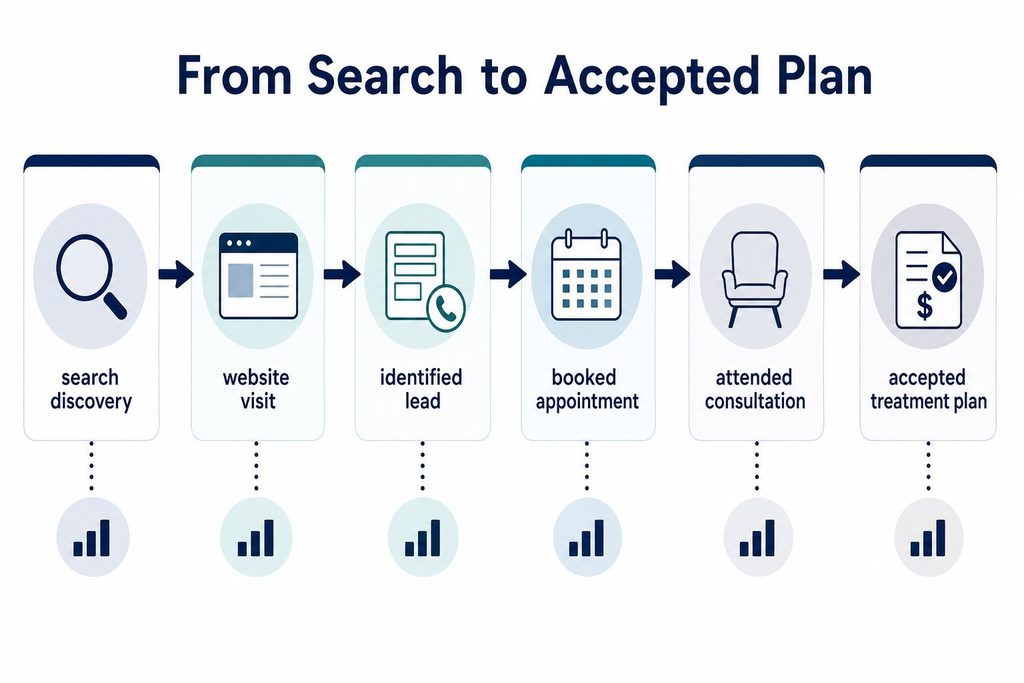
Revenue is the last link in a chain that starts with exposure and ends with an accepted treatment plan, and every link between those two points can be measured separately. Skipping that measurement is how a practice ends up funding a channel that generates activity without generating income.
How Does Discovery Become a Lead?
Channel exposure, whether organic search, paid search, or a shared review, produces the input: a visit to the website. The transformation is what the page does with that visit, converting an anonymous session into an identified lead through a form, a call, or a booking widget. The output is a named prospect the practice can follow up with directly.
How Does a Lead Become Booked Treatment Value?
The identified lead is now the input to a second transformation: the intake and consultation process. A well-run consultation converts interest into an accepted treatment plan, at which point the output becomes a dollar figure, the value of that accepted case, which can be set directly against what it cost to acquire.
This is where appointment fill rate and patient lifetime value become the real scoreboard. A channel producing fewer leads but a higher share of attended, accepted consultations can outperform a channel producing three times the volume with a fraction of the follow-through. Judging channels by lead count alone rewards the wrong behavior, because it ignores what happens after the lead arrives.
A lower-volume, higher-cost-per-click channel is sometimes the more defensible spend, precisely because its leads convert to booked treatment more often. Volume without conversion is not evidence of return. It is evidence of spend.
Which Numbers Show Whether Digital Marketing Is Paying Back?
A short, consistent set of numbers, tracked together, is what separates a defensible marketing decision from a guess dressed up as strategy.
- Website traffic: the volume entering the system, meaningful only relative to what it produces downstream.
- Leads and conversion rate: how many visitors become identifiable prospects, and at what rate.
- Cost per lead: what each identified prospect costs to generate.
- Appointment fill rate: how many leads actually show up for a booked visit.
- Booked treatment value and patient lifetime value: what accepted cases are actually worth, immediately and over time.
- Return on investment: treatment value generated against total acquisition cost.
Rising traffic paired with flat leads points to a conversion problem on the site, not a channel problem. Cheap leads paired with poor attendance point to an intake or follow-up failure, not a targeting failure. The number that looks wrong tells the practice exactly where to look next.
What Is the Smallest Sensible First Investment Decision?
Before expanding any channel’s budget, trace one prospective cosmetic or implant consultation, individually, from the exact channel it came from through to a booked and attended appointment. If that path cannot be reconstructed for even one patient, no dollar amount spent upstream can be judged sound.
If a practice does nothing else this quarter, approve only digital activity that can be tracked from channel to booked high-value consultation.