

What happens to a marketing budget in the eleven months when there is no storm?
Most roofing-company leadership teams can answer that question for the week after a hailstorm. Phones ring, inspection calendars fill, and the agency invoice looks justified by the sheer volume of activity it appears to have produced.
Far fewer can answer it for a quiet October, when the same agency, the same spend, and the same reporting dashboard have to produce a different kind of lead against a market that is not handing out demand for free.
That gap between storm-driven attention and planned replacement demand is where most agency evaluations go wrong. Proposals are written and pitched in the language of the surge. The commercial test that matters happens in the months without one.
Why Does a Storm Surge Not Equal a Year-Round Pipeline?
Storm damage inquiries and roof replacement inquiries look similar on a lead report. Both arrive as a name, a phone number, and an address.
Commercially, they behave nothing alike. Storm damage volume tracks weather events, insurance timelines, and neighborhood word of mouth, all of which an agency influences only at the margins.
Replacement demand tracks aging roof stock, homeowner budget cycles, and search intent that has to be captured deliberately, month after month, without a hailstorm doing the work.
What Storm-Triggered Demand Actually Requires
Storm-triggered demand rewards speed and geographic precision. An agency that performs well here can stand up hyperlocal campaigns fast, target the specific streets or zip codes affected, and route call volume without overwhelming a crew that suddenly has more leads than estimators. The skill being tested is responsiveness, not sustained demand generation.
What Planned Replacement Demand Actually Requires
Replacement demand rewards patience and consistency. It depends on search visibility for people typing “roof replacement cost” or “how long does a roof last” months before they call anyone. It depends on retargeting that survives a slow decision cycle. And it depends on content that answers real homeowner questions rather than chasing keywords for their own sake.
A 2026 roofing lead-generation playbook identifies ten distinct lead channels available to roofing companies, which is a useful reminder that no single tactic, however well it performed during a storm, is built to carry replacement volume on its own.
The operational implication is direct: an agency has to plan, staff, and report for both types of demand as separate lines, not as one blended lead count. A reporting dashboard that mixes the two hides exactly the information a leadership team needs, which is whether the business can survive a season with no storm at all.
What Does a Weak Agency Relationship Cost Beyond the Retainer?
The retainer is the visible cost. It is rarely the largest one.
- Opaque account ownership is the first hidden cost, and it compounds. When ad accounts, tracking pixels, and call-tracking numbers live inside an agency’s own logins rather than the client’s, switching agencies later means starting the data history over. That has a direct effect on customer-acquisition cost calculations, because a new agency inherits no baseline and has to relearn what already worked.
- Vanity reporting is the second cost. A report that leads with impressions, clicks, or “leads generated” without a qualified-lead definition tells a leadership team almost nothing about revenue quality. Inquiry cost only means something once it is measured against inspection-booked rate and close rate, and an agency that cannot produce those numbers is, functionally, reporting on its own activity rather than the client’s business.
- Unreviewed calls and duplicated targeting create a third kind of cost, one that shows up as wasted ad spend rather than a line item anyone flags directly. If nobody listens to a sample of the calls an agency’s campaigns generate, there is no way to know whether the traffic is landing on people who own a roof, live in the service area, or ever intended to book an inspection.
- The final, and often most damaging, cost is volume without capacity. An agency that generates leads faster than estimators can call them back is not creating pipeline. It is creating a queue of cooling inquiries and a show rate that erodes month over month, while the invoice stays the same.
A lead that never had any chance of becoming a customer costs exactly the same to generate as one that does.
That single fact is the entire argument for call review, and it is why lead volume without a qualification method should be treated as a warning sign rather than a selling point.
Reported figures for roofing paid-search leads have ranged from roughly $235 to $310 per lead in well-managed campaigns, with markets under storm pressure sometimes running past $550, according to a 2026 industry cost analysis. Numbers in that range only make commercial sense if the agency can also show what happened after the lead arrived: booked, shown, closed, or wasted.
What Evidence Should an Agency Produce Before It Is Shortlisted?
Every claim an agency makes in a pitch deck is a hypothesis until it is checked against something outside that pitch deck. The question is not whether the agency sounds credible. It is whether the agency can produce evidence that would still hold up if someone else went looking for it.
The following items should be treated as a pass or fail check, run before any agency reaches a shortlist:
- Roofing-relevant case examples exist and name real markets. Generic home-services results do not substitute for evidence in storm and replacement demand specifically.
- Reference access is granted, not just offered. A phone number or email for a named current client, reachable without the agency present on the call.
- Account and data ownership is documented in writing. Ad accounts, analytics, and call-tracking numbers register to the roofing company, not the agency.
- A written qualified-lead definition exists before the contract starts, not after the first month of reporting disputes.
- Call tracking and a review method are already in place, with a sample of recorded calls available for the roofing company to listen to.
- Attribution runs through booked inspection and, where available, through sale, rather than stopping at lead capture.
- Service-area logic is explained, showing how targeting avoids overlap with the company’s own crews or with a competing client of the same agency.
- Exclusivity terms are stated plainly, including whether the agency works with a competitor in the same service radius.
- Reporting cadence is fixed in the agreement, with a named format and a named frequency, not “regular updates.”
- Contract exit terms are readable without a lawyer, including what happens to accounts and data on termination.
- A capacity plan exists for what happens when lead volume outpaces estimator or call-handling bandwidth, agreed before it happens rather than negotiated after.
None of these require the agency to promise a result. They require the agency to show a process that already exists and can be inspected, which is a materially lower bar than a performance guarantee and a materially higher bar than most pitch decks clear.
How Can an Agency Be Verified Online and Near the Service Area?
Ranking near the top of a search for “roofing marketing agency near me” proves the agency knows how to market itself. It does not prove the agency knows how to market a roofing company.
Proximity and visibility are starting points for a shortlist, not evidence of competence, and treating them as the same thing is one of the more common errors in this decision.
The distinction becomes clearer when a specific signal is set against the underlying proof it should be checked against.
| Signal Checked | Red Flag | Inspectable Proof |
|---|---|---|
| Client reviews | Generic five-star praise with no project detail | Reviews naming specific roofing outcomes, storm response, or inspection speed |
| Portfolio relevance | Home-services work with no roofing-specific examples | Named roofing clients with visible campaign structure or landing pages |
| Reference access | Testimonials only, no live contact offered | A current client reachable directly, without agency staff present |
| Local and service-area targeting | Broad claims of “local expertise” with no geography named | Documented service-area logic tied to actual campaign settings |
| Account access | Agency-owned logins with no transfer clause | Written terms confirming client ownership of ads, analytics, and tracking |
| Reporting method | Screenshots of dashboards with no lead definitions | A reporting sample tied to a stated qualified-lead definition |
Every row on that table can be checked outside a sales call, which is exactly the point. Legitimacy, in this decision, is not a feeling produced by a confident pitch.
What Is the Best Marketing Mix for Storm and Replacement Demand?
No channel earns the label “best” in the abstract. The right mix depends on the company’s service area, its capacity to handle a lead surge, its current offer, and, critically, what its attribution data already shows about where past customers came from. An agency that proposes a fixed channel mix before reviewing any of that is proposing a template, not a plan.
- Hyperlocal targeting and neighborhood segmentation earn their place around storm events, when speed and geographic precision matter more than broad reach.
- Local visibility and organic search demand capture earn their place for replacement inquiries, where the homeowner’s decision cycle is longer and less predictable.
- A conversion-ready website path, one that gets a visitor to a phone call or a form with minimal friction, has to support both, since a fast-moving storm lead and a slow-moving replacement researcher are landing on the same site through different doors.
The test that separates a real plan from a template is whether an agency can show, in its own reporting structure, how storm damage inquiries are tracked apart from year-round roof replacement inquiries. A roofing marketing agency that blends both into one lead count has effectively decided that the difference does not matter to its own accountability, which is a different decision than the one the roofing company is making with its money.
How Should a Roofing SEO Agency Be Assessed?
Search rankings are the easiest thing to promise and the hardest thing to convert into revenue without the rest of the system working.
A roofing SEO agency should be assessed on observable work, not on assurances about position on a results page, because a page-one ranking that produces no booked inspections has no commercial value regardless of how it looks in a rank tracker.
The check runs through a short sequence of questions, each aimed at a different point where SEO work either produces revenue or quietly fails to.
- Are service pages built for real coverage areas? Pages should reflect the specific cities and zips the company actually serves, not a generic template repeated across markets.
- Is the site technically sound? Pages should load, index, and render on mobile without errors that a crawler would flag.
- Are call and form paths tracked? An organic visit needs to be tied to an actual inquiry, not just a session count.
- Does the content answer real questions? Repair timing, replacement cost, and insurance claims deserve real answers, not keyword variations stuffed into thin pages.
- Is there a documented path from ranking to revenue? Search visibility without a route from inquiry to qualification, and from qualification to booked inspection, is a metric in search of a business outcome.
An agency that cannot walk through that path, including how it manages ranking in service areas that overlap with a competing client, has not yet earned the SEO budget line.
What Must Be Agreed Before Onboarding Begins?
Onboarding is where good intentions from the pitch meeting either turn into working systems or fail to. The following checks belong in writing before the first campaign goes live, grouped by what they govern.
Commercial terms:
- Advertising account ownership and data ownership are documented, not assumed.
- The qualified-lead definition is approved in writing by both sides.
- Exclusivity and service-area boundaries are confirmed in the agreement.
- The reporting cadence and format are fixed, with a named date each cycle.
Operating handoffs:
- Baseline access to existing accounts, if any, is granted and tested before launch.
- Call tracking is tested end to end, with a sample call reviewed by both sides.
- Response-time assumptions for new inquiries are written down and agreed by the sales team, not just the agency.
- Sales capacity thresholds are set, defining what happens if lead volume exceeds what estimators can handle in a given week.
- Storm-response campaigns and replacement campaigns are built and budgeted as separate lines from day one.
- Compliance responsibilities, including any state-specific claim or roofing-code language, are assigned to a named party.
A roofing company operating where building code provisions still reference a repair-area threshold, the kind of 25 percent language that has shaped roofing regulation debates in jurisdictions like Florida, needs that compliance ownership question answered before any campaign references code-driven urgency in its messaging.
Skipping this step does not remove the liability. It just delays discovering who was supposed to be watching it.
How Is Lead Quality Tracked From Call to Revenue?
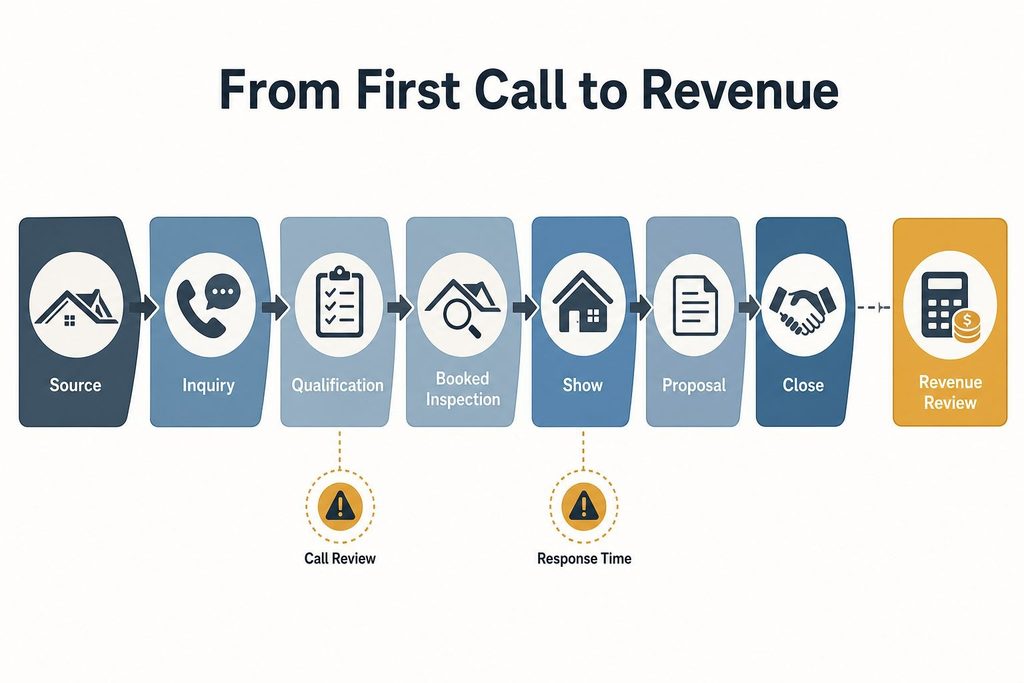
A lead’s usefulness is only visible once it is followed through a chain:
- source
- inquiry
- qualification
- booked inspection
- show
- proposal
- close
The final step is a review of what that revenue was actually worth after acquisition cost.
Call review and response time are where this chain most often breaks. A slow callback or an unqualified inquiry can look identical to a good one on a lead-count dashboard while producing nothing at the close stage.
An agency proposing to manage this pipeline should be able to walk through that flow with real numbers from a past client, not describe it in the abstract. Optimization is a claim that only means something once the measurement it is optimizing against already exists and can be shown.
What Request Should Be Sent to an Agency Today?
The single next step is small and does not require a meeting. Send the same written request to every agency still on the shortlist, before any further sales conversation, and compare what comes back rather than what was pitched.
Please send: two roofing-specific case examples with a reachable reference for each; written terms confirming ownership of ad accounts and tracking data; a proposed qualified-lead definition; how attribution runs from inquiry through booked inspection and sale; and how storm damage and roof replacement inquiries are separated in campaign and reporting structure.
What comes back from that one email will say more than anything in the original proposal.